
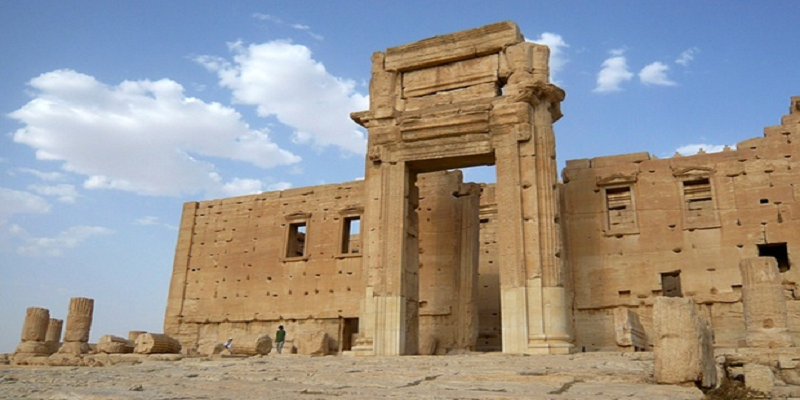

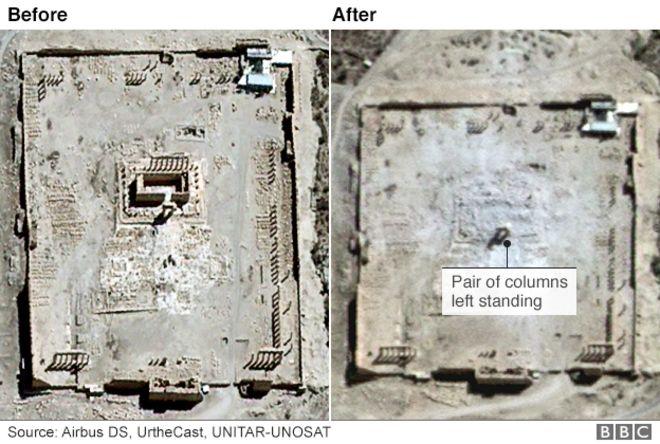
The destruction of the temple was only the latest blow to Palmyra, which had been mostly razed by ISIS over the past year. All that remained of the Temple of Bel was an archway that marked its entrance. Such a loss is devastating, but a group of archaeologists are determined to show ISIS that they have not won. The Institute for Digital Archaeology, a collaboration between the University of Oxford, Harvard University and the Museum of the Future, began distributing 3D cameras to volunteers around the Middle East and Africa earlier this year, with the goal of gathering images of threatened monuments in case they were destroyed. The Temple of Bel was brought down before it could be captured by the Million Image Database Project, but enough two-dimensional images exist that 3D renderings of the temple can be made.
Using those renderings, the IDA will create a 3D model of the temple’s remaining arch, which will then be 3D printed and assembled in London’s Trafalgar Square and New York City’s Times Square as an act of solidarity with Syria and defiance of ISIS.
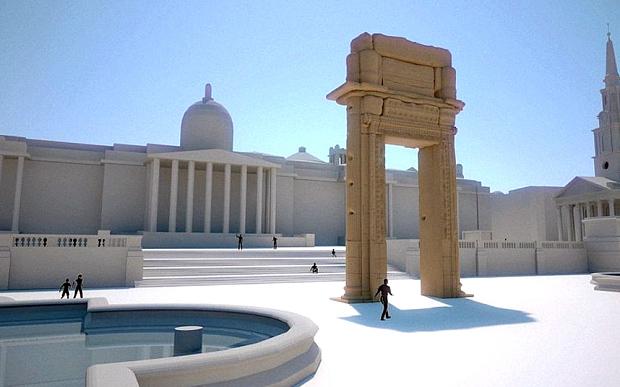
A digital rendering of the archway’s reconstruction in Trafalgar Square [Image: IDA]
“It is really a political statement, a call to action, to draw attention to what is happening in Syria and Iraq and now Libya,” said Roger Michel, executive director of the IDA. “We are saying to them if you destroy something we can rebuild it again. The symbolic value of these sites is enormous, we are restoring dignity to people.”

“We tend to think about cultural heritage in a somewhat parochial way,” Karenowska said. “We also think of other people’s cultural heritage as being something that’s particular to them. We see that very much with the Middle East. People in the west find it very easy to say that the Middle East have this great cultural heritage and this problem is something that’s happening to them. The idea is to underline that cultural heritage is something that’s shared between people. It’s about people’s roots and it’s important to recognise also that this is something that as humans we do all understand on some deep level.”
The replicas are set to be erected as part of a World Heritage Week in April. The despair that ISIS leaves in its wake is pervasive, but projects such as this one and Project Mosul send a powerful symbolic message that all is not lost, not completely. Nothing can replace the lives lost through terrorist attacks, but the reconstruction of shattered monuments hopefully shows ISIS that despite its best efforts, it cannot fully stamp out the culture and history of the people it seeks to destroy. Discuss this remarkable story in the 3D Printing to Combat ISIS forum on 3DPB.com.
[Source: The Guardian]