HII’s NXG 600E Order Shows Why Nikon Dominates Large Defense AM Systems

Huntington Ingalls Industries‘ (HII) Newport News Shipbuilding (NNS) unit has ordered a Nikon SLM Solutions NXG 600E. HII is a $11 billion revenue shipbuilder that builds the Gerald R. Ford-class aircraft carriers and the Columbia-class nuclear submarines. These are some of the major weapons of war the US has, and a big part of its global ability to project power. The company’s Newport News Shipbuilding subsidiary is in Newport News, Virginia. There, the firm is working on the USS John F. Kennedy (CVN-79) and USS Enterprise (CVN-80). That shipyard made its first warship, the Kearsarge, in 1898.
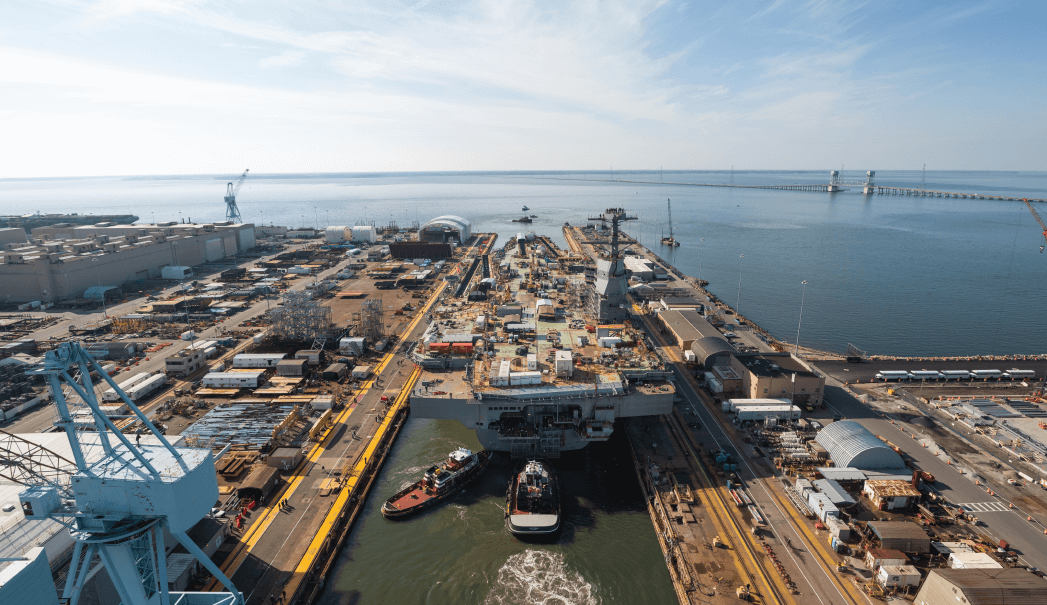
Tugboats move the aircraft carrier John F. Kennedy from Newport News Shipbuilding’s Dock Dry 12 to Pier 3 on Monday, where the ship will undergo final completion and outfitting. Image courtesy of Huntington Ingalls Industries.
NNS is an essential supplier to the US government. Nuclear submarines are a big portion of the US nuclear deterrent, and their invisibility means that it would be daft to attack the US in that way. The subs can also monitor other nations’ submarines and launch conventional missiles pretty much undetected globally. There’s only one other company, General Dynamics Electric Boat, that the US trusts to make submarines. Given what is at stake and the tens of billions involved, this is a significant purchase.
This purchase follows a previous partnership with the Maritime Industrial Base (MIB), which made an NXG 600E machine available for supplier qualification and training for the US Navy. This made it much easier for companies to qualify parts, test business cases, train staff, and industrialize 3D printing. That will have done much to let NNS adopt Additive with less risk in less time. That system was set up to use Copper Nickel (CuNi), which is a rare material in our industry as a whole but is extensively used in marine components. Things like submarine propellers, valve components, piping, and general ship propulsion components are made from this material. If the US were to use additive manufacturing to make submarine propulsion components, then it would allow 3D printing to make some of the most sensitive and critical components in the US inventory. If the sub propulsion designs were known, adversaries could come up with ways to track submarines, for example. This would reduce or eliminate a significant component of the US nuclear triad.
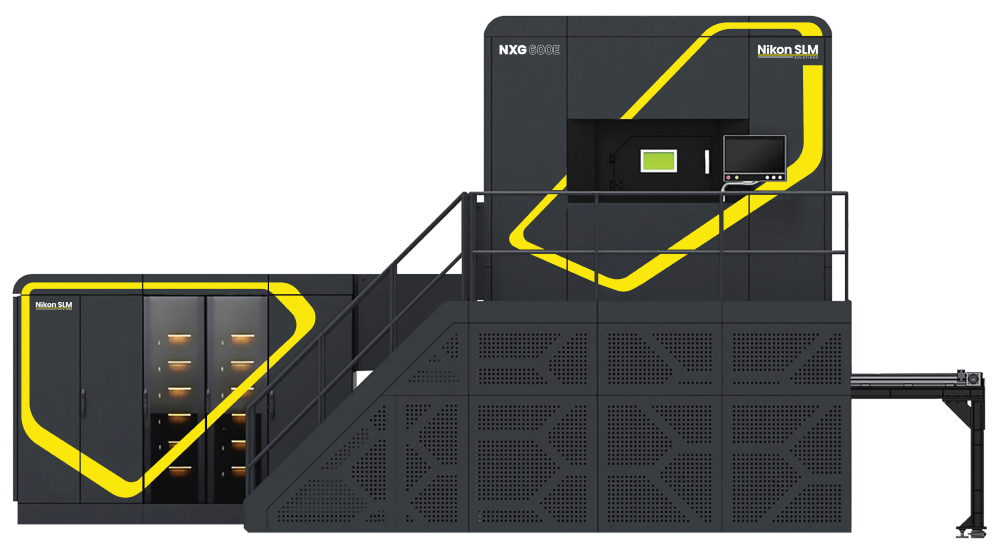
Nikon SLM Solutions NXG 600E system. Image courtesy of Nikon SLM Solutions.
The US is doing a bang-up job of eliminating a portion of its nuclear triad as is by building too few ships too slowly. The ageing Ohio class, in service for over four decades, is to be retired around 2028, while the newer Columbia class (a nuclear-powered ballistic missile submarine that is a direct Ohio replacement) may not be ready in time. The Columbia program is said to cost around $132 billion, but it will probably be much higher than that. $132 billion is around the GDP of Ecuador or Kenya. Or to put it another way, the program cost is 377,142 Ferraris.
Whereas for others, an NXG is a rather big purchasing decision, it’s a mere drop in the bucket here.
Nikon Advanced Manufacturing CEO Hamid Zarringhalam said,
“This latest NXG 600E order underscores the strategic importance of metal additive manufacturing to U.S. Navy shipbuilding programs, and marks another milestone in Nikon AM’s holistic approach towards scaling the defense industrial base on U.S. shores. We are proud to strengthen our relationship with HII and the Navy to deliver the AM capabilities that are imperative to national security.”
Nikon could sell many more systems into HII if this one is successful. If it is just used for a limited propulsion component, it is still very important. The volume can also be considerable. It’s doubtful that HII will stay at just one NXG. Across the Navy and its suppliers, many more could be sold additionally. By making large systems in the US, Nikon has a real advantage in capturing the large parts for the defense business. Will anyone challenge Nikon in this lucrative and growing segment? If we look at the market, the competition is heating up in low-cost systems and the quad 300 segment. But, so far, no one is really challenging Nikon for large defense part production in the US. In China, meanwhile, dozens of laser systems abound. Will someone be able to produce a competitor at one point? Or will this be a market for Nikon alone to conquer?
Subscribe to Our Email Newsletter
Stay up-to-date on all the latest news from the 3D printing industry and receive information and offers from third party vendors.
Print Services
Upload your 3D Models and get them printed quickly and efficiently.











You May Also Like
Materialise Launches New CO-AM Tools Amid New Industrial Phase in AM Software
When Materialise launched its CO-AM platform about three years ago, the company aimed to leverage cloud-based engineering capabilities to enhance the openness of the additive manufacturing (AM) software experience and...
3D Printing News Briefs, November 15, 2025: Subsidiary, Reshoring, FDA Clearance, & More
We’re kicking off this weekend’s 3D Printing News Briefs with some business news. Replique has opened an Italian subsidiary, and 3D People is championing local additive manufacturing. Meteor Inkjet and...
Europe’s Reshoring Moment: How AM Can Power Industrial Recovery
For years, Europe has seen much of its manufacturing base shrink as production has moved overseas and global competition has increased. Now, the region is trying to bring that work...
Authentise Expands Its Platform to Unify the Front Office and Factory Floor
Authentise has made a number of announcements this year demonstrating the consistent buildup of its unique additive manufacturing (AM) platform, with projects focused on strategically critical applications like defense and...